
For more than a decade, programmatic advertising revolved around a single obsession: identity. Every impression was judged by one question—who is this user? To answer it, the industry built an elaborate web of third-party cookies, cross-device graphs, and probabilistic IDs, all designed to follow people across the internet.
That era is ending.
Between privacy regulations like GDPR and CCPA, platform-level changes such as Apple’s ATT framework, and the steady erosion of third-party cookies, identity-based targeting has become increasingly fragile. More importantly, it has become less reliable. Knowing what someone clicked days ago tells you very little about what matters to them right now.
As media planning moves into 2026, a more resilient, privacy-first model is taking hold: signal-based advertising. Instead of reconstructing who a user might be, this approach focuses on understanding the moment they are in.
What Signal-Based Advertising Really Means
Signal-based advertising relies on real-time, non-personal indicators to evaluate the relevance of an impression. These signals describe context, environment, behavior, and creative response—not identity.
In the identity era, targeting looked like this:
A 35-year-old who searched for running shoes last week.
In the signal era, it looks like this:
An anonymous user reading a marathon training article on a mobile device at 7 a.m., scrolling slowly, in a city where it’s currently raining.
The second scenario is far more predictive of intent. By focusing on conditions instead of profiles, advertisers gain immediacy without compromising privacy.
The Five Signal Pillars Shaping Modern Media Buying
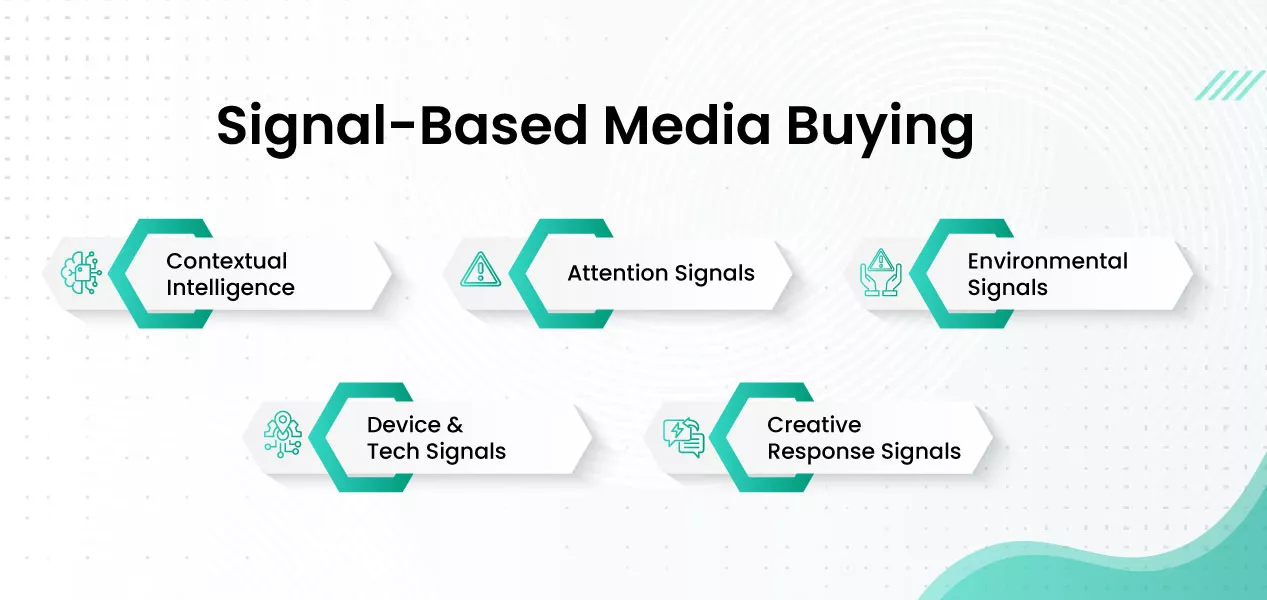
To operate effectively in this model, advertisers now evaluate impressions through a cluster of real-time signals:
Contextual intelligence
Modern contextual targeting goes beyond keywords. AI-driven semantic analysis interprets tone, subject depth, and sentiment, helping ads align with the mindset of the content being consumed rather than just its vocabulary.
Attention signals
Metrics like dwell time, scroll behavior, and active tab focus reveal whether a moment is worth bidding on. This shift toward attention as a quality signal reflects the broader industry move away from surface-level exposure, where viewability alone no longer predicts impact.
Environmental and moment-based signals
Time of day, weather, and location all influence receptiveness. Morning browsing, late-night scrolling, or commuting behavior each carries different intent—and signals allow campaigns to adapt accordingly.
Device and technical context
Screen size, operating system, connection type, and orientation affect how creative should appear. A high-bandwidth desktop session supports different formats than a mobile user on the move.
Creative response signals
Performance feedback loops reveal which creative elements are resonating right now. If certain layouts, colors, or messaging styles begin outperforming across similar environments, those signals inform the next bid—without ever identifying the user.
Why Signals Outperform Identity
This shift isn’t just about compliance. It’s about effectiveness.
Identity-based data is inherently stale. It reflects past behavior, often disconnected from current intent. Signals, by contrast, are live. They capture what is happening in the moment an impression becomes available.
Signals also scale more cleanly. Identity targeting depends on match rates and fragmented datasets. Signal-based strategies operate across the entire open internet, including environments where cookies never worked reliably in the first place.
Most importantly, signals are privacy-resilient by design. They eliminate dependence on personally identifiable information, giving media strategies long-term stability as regulations continue to evolve.
Navigating the Signal Era in Practice
To use signal-based techniques, you need infrastructure that can read and understand more than one input at a time. This is when programmable architecture comes into play.
Platforms that use real-time decisioning, especially those that work with contemporary Demand-Side Platforms (DSPs), are better at weighing contextual relevance, attention quality, and environmental variables on a large scale. Cleaner inventory pathways on the supply side help keep the signal strong; therefore, supply-side restrictions are necessary for proper evaluation.
At Admozart, signal interpretation is built into how impressions are evaluated instead of being a separate reporting layer that comes after the fact. By looking at how context, attention, and environment come together, campaigns may be improved around times that always lead to significant interaction, without keeping track of individual users.
Planning for 2026: From Audiences to Signal Clusters
As advertisers rethink their media plans, the questions need to change.
Instead of asking which audience segments are available, it’s time to ask which signal combinations drive outcomes. High-quality environments, strong attention indicators, and responsive creative patterns are now better predictors of performance than identity ever was.
The decline of user tracking isn’t the end of digital advertising. It’s a correction. Signal-based advertising replaces assumption with observation and replaces surveillance with relevance. In a post-identity world, the most valuable data isn’t who someone was—it’s what the moment is telling you now.
Comments are closed