For a long time, creative performance in advertising followed a familiar pattern. You launched two versions of an ad, split traffic, waited for enough data, and declared a winner. A/B testing became the industry’s comfort zone. It gave teams answers they could defend in meetings, even if those answers were often incomplete.
But heading into 2026, that approach will no longer be enough.
Advertising today moves too fast, media environments are too fragmented, and attention is too scarce to rely on post-campaign conclusions alone. Knowing which creative won isn’t the same as understanding why it worked—or how to repeat that success across formats, channels, and audiences. This is where Creative Intelligence is changing the conversation, moving programmatic advertising beyond experimentation and into interpretation.
Why A/B Testing Hit Its Ceiling
A/B testing was never designed to explain creative behavior. It treats the ad as a black box. One version performs better, the other doesn’t, and the analysis usually stops there. Was it the headline? The color contrast? The emotional tone? The placement of the CTA? Traditional testing can’t answer those questions with confidence.
As programmatic strategies mature, advertisers are realizing that performance gaps are rarely accidental. Patterns exist—but they sit inside the creative. Extracting those patterns at scale requires AI-driven creative analysis, not more test variations.
This shift mirrors what we’re already seeing in the move from viewability toward attention metrics, where surface-level signals no longer explain real outcomes. Creative Intelligence applies the same logic to the ad itself.
Looking Inside the Creative, Not Just At the Result
Creative Intelligence uses machine learning and computer vision to break ads down into their smallest components, what many platforms now refer to as the creative’s DNA. Every frame, layout choice, color palette, object placement, and emotional cue becomes measurable.
Instead of asking, “Did this ad win?” the system asks:
- Which visual elements held attention longer?
- Which emotional signals aligned with higher engagement?
- Which creative structures fatigued fastest?
This level of insight becomes especially valuable when creatives are distributed across complex ecosystems managed through programmatic infrastructure like Demand-Side Platforms (DSPs), where the cost of guessing is amplified at scale.
Frame-Level Analysis Changes How Video Is Built
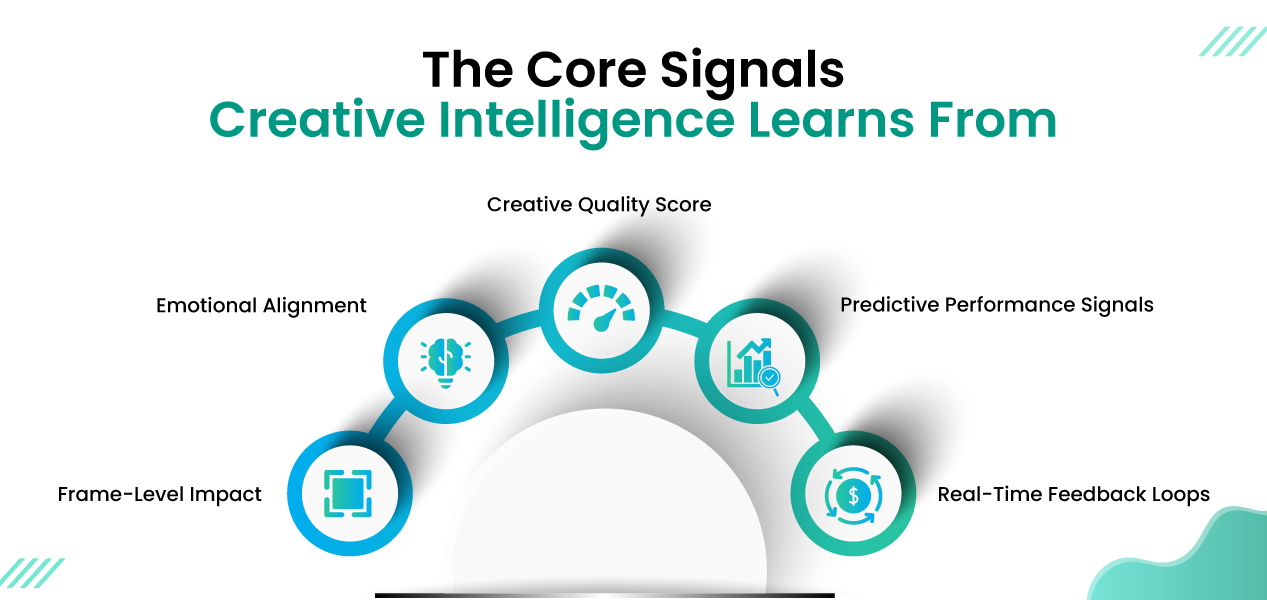
One of the most practical breakthroughs in Creative Intelligence is frame-level analysis. AI evaluates video ads moment by moment, tracking where attention rises, drops, or stalls.
Patterns start to emerge. Some creatives lose viewers before the brand even appears. Others do better when a real face is shown early on. Results can be affected by where the CTA is, how the background moves, and even how fast the camera moves, especially on phones and TVs that are connected to the internet.
Instead of making videos from scratch every time performance goes down, teams can now use patterns that they know work to make their videos more creative. This cuts down on creative waste and makes the path from idea to performance shorter.
Emotion Is No Longer Guesswork
Emotion has always mattered in advertising, but measuring it was subjective. Today, emotion detection AI makes it observable.
By analyzing facial expressions, visual cues, motion intensity, and tonal consistency, AI models can identify emotional patterns that correlate with outcomes. A calm, minimal aesthetic might support consideration-stage goals, while dynamic, expressive visuals may perform better for acquisition-focused campaigns.
This insight allows advertisers to align emotional tone with intent, rather than relying on intuition or creative preference. Over time, this improves creative ROI while reducing fatigue caused by mismatched messaging.
Creative Quality Scoring
Another quiet but powerful shift is creative quality scoring. Instead of discovering problems after money is spent, AI evaluates creatives before they ever enter the auction.
Elements like clutter density, logo visibility, mobile readability, and predicted engagement probability are benchmarked against historical performance data. Poor-performing patterns can be corrected early, saving budget and preventing low-quality impressions from ever going live. This approach pairs naturally with supply-side controls, especially when inventory quality and creative suitability need to align across publisher environments.
Predictive Performance and Real-Time Learning
Where Creative Intelligence truly differentiates itself is in its ability to anticipate performance before spending is committed. By analyzing how creative elements interact with context, format, and environment, AI can forecast which version of an ad is most likely to hold attention and drive impact in a given placement.
Instead of running multiple live tests to discover what works, predictive models assess factors like contrast, pacing, messaging density, and visual hierarchy to determine creative suitability upfront. This reduces wasted impressions and shortens the feedback loop between insight and execution.
As campaigns progress, these models continue learning in real time. Signals such as dwell patterns, scroll behavior, and exposure quality help identify when creatives begin to fatigue or lose relevance, allowing delivery logic to adjust dynamically. This aligns closely with the broader shift toward attention-based optimization, where performance is measured not by whether an ad was seen, but by whether it earned meaningful focus.
Where Admozart Fits In
At Admozart, Creative Intelligence isn’t treated as an isolated reporting layer. It’s a part of how material is planned, optimized, and sent out across all platforms. Creative insights help choose, order, and transport merchandise so that the correct message emerges in the right place at the right time.
This way of thinking is quite similar to how AdMozart thinks about channel strategy in general, where creative quality, attention, and context all work together across media channels.
From Testing to Comprehending
As we get closer to 2026, teams that know why creatives work, not just which one won a test, will be the ones that succeed in advertising. Creative Intelligence helps companies make commercials that get attention instead of chasing it by using interpretation instead of trial and error.
When advertisers know how their creative works, they don’t simply win auctions; they also make messages that stick. And in a world when people don’t have much time to pay attention, that knowledge is what gives you the edge.
Comments are closed