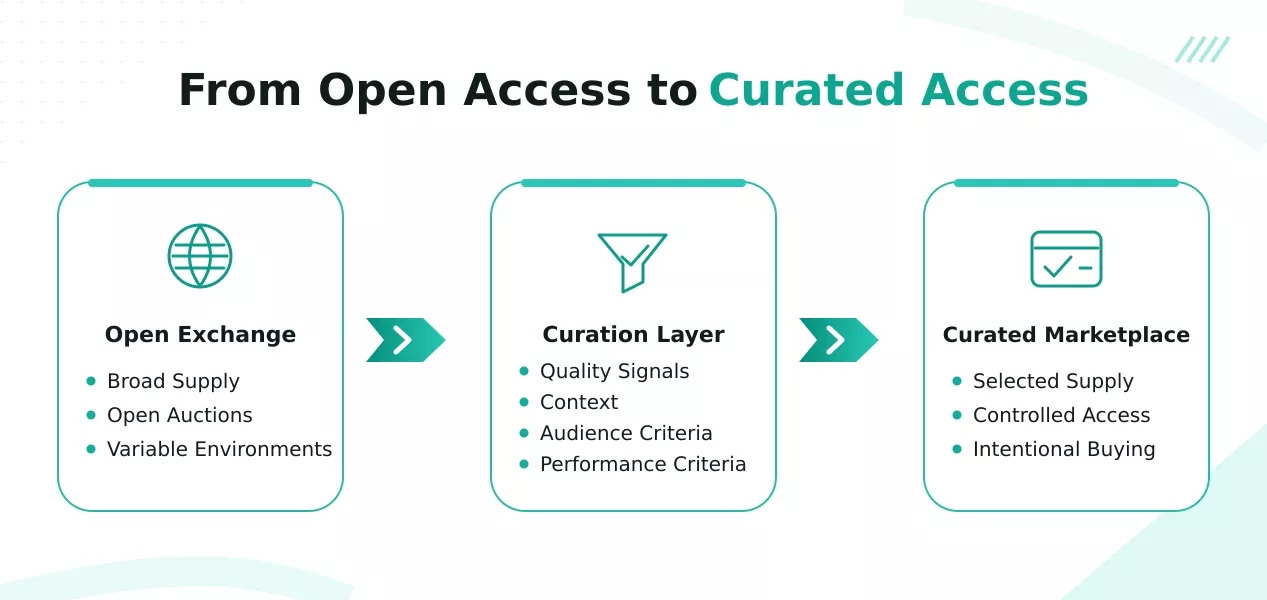
Open exchanges solved one of programmatic advertising’s earliest challenges: access. Advertisers could reach enormous pools of digital inventory without negotiating with publishers one by one.
But as access became easier, a different challenge emerged. How do you decide which inventory is actually worth buying?
More supply does not automatically mean more value. When advertisers bid across broad pools of inventory, they also have to navigate varying publisher environments, reseller relationships, traffic quality, and contextual relevance. That is changing how media teams think about scale.
Instead of accessing everything available and filtering later, curated Private Marketplaces in programmatic introduce greater selection earlier in the buying process. The shift is less about abandoning scale and more about putting better controls around it.
Where Open Exchange Scale Gets Complicated
Open exchanges remain an important part of programmatic advertising. They provide reach, flexibility, and access to a wide range of inventory. The challenge appears when scale becomes the primary buying criterion.
An impression may be available through different sellers and supply paths. Inventory quality can vary significantly across the open web. Advertisers must also account for invalid traffic, brand suitability, contextual relevance, and the economics behind each opportunity.
That creates a simple problem: more available impressions also mean more decisions about which impressions deserve investment. This is where the distinction between access and intentional access becomes important. A large supply pool gives buyers options. Curation helps determine which of those options align with a particular campaign objective.
Curation Happens Before the Bid
Curation changes the point at which selection happens. Rather than exposing buyers to an unrestricted pool and relying entirely on downstream bidding decisions, inventory can be grouped according to predefined criteria. Those criteria might include publisher characteristics, contextual categories, audience signals, geography, performance requirements, or supply-path considerations.
The result is a more focused marketplace built around a specific buying need. This is the thinking behind curated Private Marketplaces in programmatic. A PMP creates controlled access to selected inventory, while curation adds another layer of intelligence to how that inventory is assembled.
It does not mean every curated deal will outperform the open exchange. It means advertisers can make more deliberate choices about the supply they want to evaluate.
Why Advertisers Are Looking for More Control
The appeal of curation becomes clearer when viewed through campaign planning rather than technology. Consider a brand that wants to reach a particular audience within relevant content environments. Buying broadly and filtering every impression during the auction is one approach. Another is to begin with a supply pool already shaped around those requirements.
That can give buyers greater control over where they compete and which opportunities enter consideration in the first place. It also complements the growing focus on premium inventory environments. The objective is not simply to reduce the number of publishers available. It is to make inventory selection more purposeful.
For media buyers, that can mean fewer irrelevant opportunities competing for attention and a clearer relationship between campaign requirements and available supply.
Curated Marketplaces Still Require Smart Buying
Moving into a PMP does not remove the need for optimization.
Price, audience relevance, creative quality, bidding strategy, frequency, and campaign objectives still matter. A controlled marketplace can improve the conditions under which buying happens, but it cannot compensate for a poorly designed campaign. This distinction matters because curated marketplace benefits should not be confused with guaranteed performance. The real advantage is greater control over the starting point.
Once an appropriate supply has been identified, technologies such as a Demand Side Platform remain responsible for evaluating opportunities and executing programmatic buying according to campaign parameters. Curation narrows the field. Buying intelligence still determines what happens within it
Supporting Smarter Programmatic Execution
The infrastructure that links programmatic supply and demand is where Admozart sees the importance of this change.
Admozart supports DSP and SSP integrations, OpenRTB-based programmatic transactions, real-time bidding, reporting, and analytics, along with machine-learning-based supply and demand path optimization.
These capabilities support the broader move toward more efficient programmatic execution without suggesting that every campaign needs to operate through the same buying model.
Whether inventory is accessed broadly or through more controlled pathways, the underlying requirement remains the same: buyers need technology that can evaluate opportunities efficiently and execute against clear campaign objectives.
From More Access to Better Access
Programmatic advertising spent years making more inventory accessible. The next stage is about becoming more selective with that access.
Open exchanges will continue to have a role where broad reach and flexibility matter. Private marketplaces and curation offer another option when advertisers want greater control over the supply entering their buying strategy.
That is ultimately what curated private marketplaces in programmatic represent: not the end of open programmatic, but a more intentional way to navigate it.
Because the question is no longer simply, “How much inventory can we access?”
It is increasingly, “Which inventory deserves our bid?”
Comments are closed