
In the post-cookie era of 2026, first-party data has become the industry’s most valuable asset. But the conversation has matured. The question is no longer how much data a brand owns. It is how responsibly that data can be activated.
For years, programmatic relied on what was quietly accepted as normal practice: the data dump. Audience lists were uploaded into DSPs. Identifiers were synced across vendors. Logs were shared across platforms. It was efficient. It was scalable. It was also fragile.
Today, that model is no longer defensible. Privacy regulations have tightened. Identifiers have collapsed. Consumers are more aware of their digital footprint. The infrastructure of advertising must evolve from data movement to data protection.
This is where the Data Clean Room enters the picture.
The Death of the Data Dump
Sending raw lists to platforms is a legacy practice. It assumes that sharing PII (Personally Identifiable Information) across systems is an acceptable cost of doing business.
It is not.
The old ecosystem was built on syncing cookies, passing IDs, and centralizing user-level information. That architecture created what can only be described as privacy debt. The more platforms that touched the data, the larger the exposure risk.
As explored in Building Programmatic Success in a Privacy-First Era, the industry has already acknowledged that compliance alone is not enough. Structural privacy is now required. Data Clean Rooms represent that structural shift.
The Neutral Swiss Vault
A Data Clean Room is best understood as neutral ground.
A brand holds its customer data. A publisher holds its logged-in audience data. Both want to understand where their audiences overlap. Neither can reveal their cards.
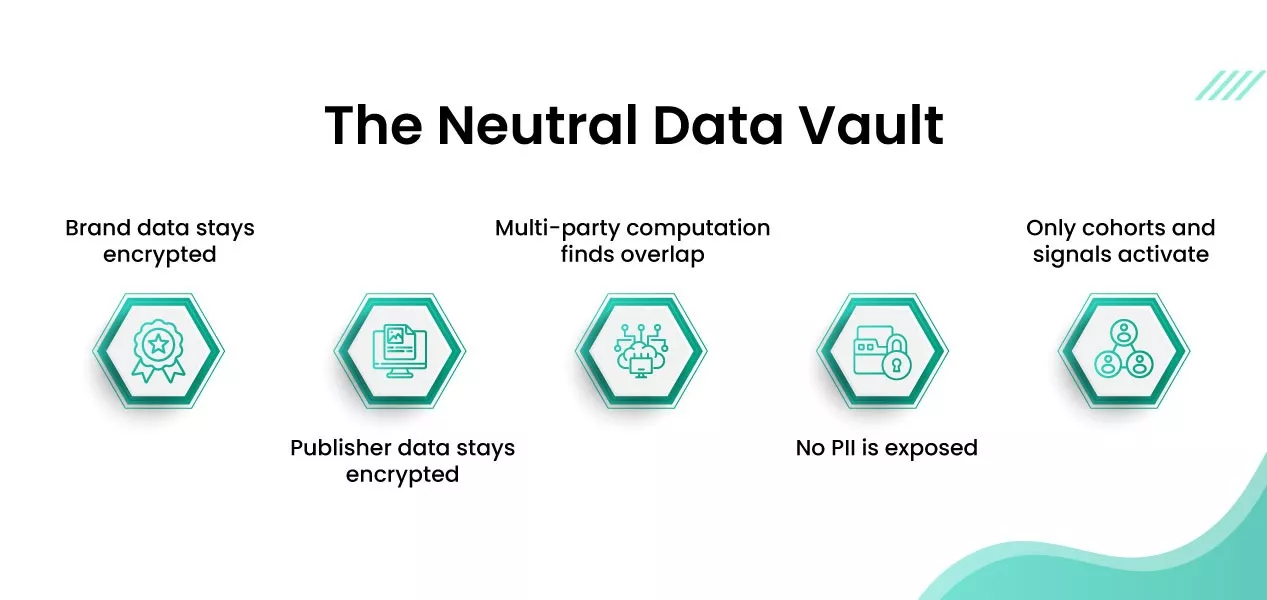
Inside a Data Clean Room, both parties encrypt their data and bring it into a secure environment. Through Multi-Party Computation and Differential Privacy, the system identifies intersections without exposing a single raw identifier.
The output is not a list of names. It is a cohort. A signal. A usable insight.
This double-blind matching ensures that privacy-safe audience matching happens by design, not by contract. No emails are shared. No raw PII leaves its origin. The data stays where it belongs.
From Data Movement to Federated Intelligence
The biggest architectural shift in 2026 is decentralization.
Instead of moving data to vendors, the industry is embracing federated learning. The intelligence travels. The data does not. This marks a fundamental change in security posture. Centralized storage once created scale. Now it creates risk.
Modern Data Clean Rooms support identity-free targeting by allowing insights to be extracted without transferring ownership of data. The infrastructure becomes interoperable rather than extractive. For institutional brands, this matters deeply. Data leakage is not just a compliance issue. It is a competitive risk.
Solving Attribution Without Cookies
Targeting is only half the equation. Measurement has become equally complex.
Without cookies, attribution has fractured. Cross-site tracking is no longer viable. The path to purchase is opaque.
Data Clean Rooms offer a solution.
By securely joining conversion data from a brand with impression data from the media side, Clean Rooms enable programmatic attribution without cookies. The matching happens inside the secure environment. The result is aggregated insight, not user-level tracking.
This allows advertisers to move beyond last-click logic and toward a privacy-safe model of true attribution.
The Activation Layer
A Data Clean Room is powerful. But it is analytical by nature.
It can tell you who matters, but it cannot start the conversation; that requires activation.
This is where Admozart becomes critical. A Clean Room generates privacy-safe cohorts. Admozart functions as the activation layer that turns those cohorts into real-time bids across the open web.
Through its demand-side platform infrastructure, Admozart can ingest secure signals without ever accessing raw PII. The system responds to high-fidelity inputs, not exposed identities.
Because the ecosystem is built around interoperability and real-time bidding logic, privacy-safe insights move seamlessly from vault to auction.
A Data Clean Room tells you who to talk to. Admozart is the engine that actually starts the conversation.
Trust as the Only Scalable Metric
In 2026, trust is not a brand value. It is infrastructure.
Consumers expect privacy. Regulators enforce it. Partners demand it.
The brands that win will not be those with the largest datasets. They will be those with the most secure and interoperable data strategies. When privacy-safe collaboration meets high-performance activation, the old tradeoff between personalization and privacy disappears.
At Admozart, we see our role as the activation layer, ensuring that secure data collaboration translates into real-time media execution without exposing identity.
The industry is no longer asking how much data you own. It is asking how safely you can use it.
And in this new era, the lock matters just as much as the gold.
Comments are closed