If 2024 and 2025 were defined by Generative AI, systems that could write copy, generate images, and assist traders with recommendations, 2026 is shaping up to be something very different. This is the year AI stops assisting and starts acting.
In programmatic advertising, the shift is clear. We are moving from co-pilots that suggest bids to autonomous agents that manage entire decision loops. These systems do not wait for approval, alerts, or manual intervention. They operate against outcomes, adjusting budgets, inventory selection, and pacing in real time across hundreds of buying paths that increasingly span complex real-time bidding environments.
This evolution is not incremental. It represents a structural change in how modern DSPs operate and how traders interact with them.
From Rules to Reasoning
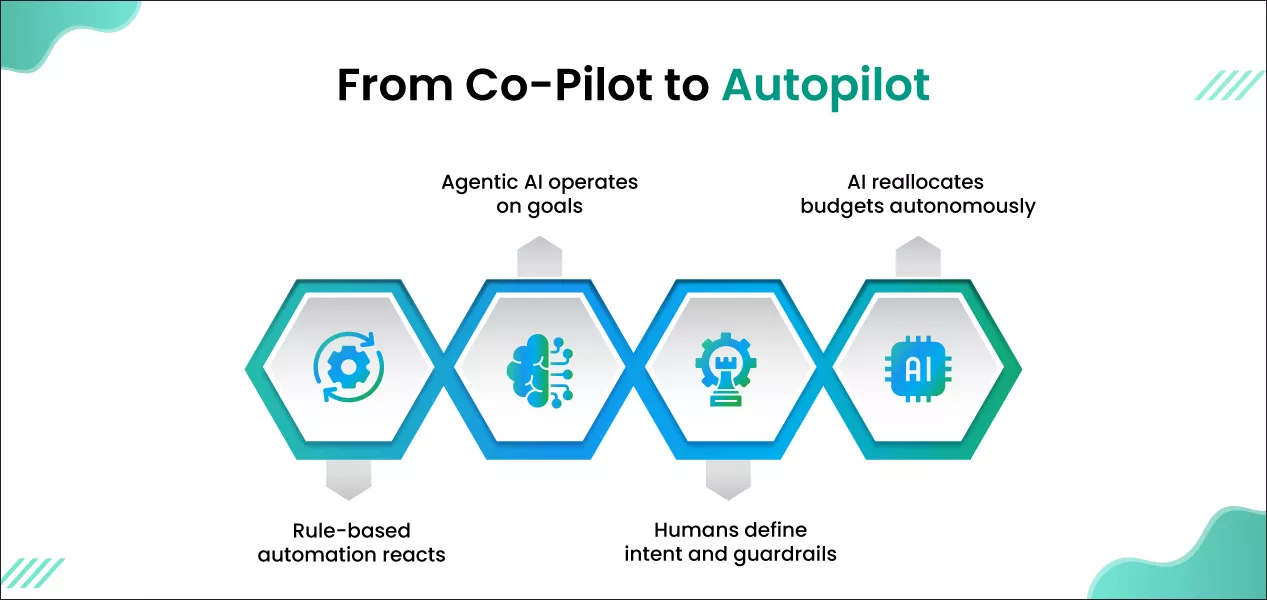
Most automation in programmatic today is still reactive at its core. It relies on predefined logic. If performance drops below a threshold, pause. If pacing accelerates, throttle. These systems are efficient, but they stop short of making decisions. They surface insights and wait.
Agentic AI works differently. Instead of following static rules, it works toward defined goals.
The distinction matters. Traditional automation executes instructions. Agentic systems interpret intent.
A useful way to think about it is the difference between cruise control and autonomous navigation. Cruise control maintains speed. Autonomous navigation observes the environment, evaluates multiple routes, adjusts in real time, and makes trade-offs to reach a destination. In programmatic terms, an AI agent does not just place bids. It continuously orchestrates spending, inventory, and signals across channels to stay aligned with business objectives across evolving media channels.
Why Complexity Has Forced the Shift
The modern programmatic landscape has outgrown human-scale decision-making.
A single campaign can involve over a hundred PMPs, overlapping contextual signals, dynamic CTV supply, and constantly shifting clearing prices. Even the most experienced trader cannot manually rebalance this ecosystem in real time. The volume of micro-decisions required simply exceeds what humans can process.
This is where Agentic AI becomes less of an innovation and more of a necessity.
Instead of managing execution, traders define intent. For example, maintain a specific effective CPA across premium video while prioritizing high-attention environments. The agent translates that intent into action across the entire supply path, operating inside increasingly sophisticated demand-side platform workflows.
Budgets self-adjust. Underperforming PMPs are deprioritized. New opportunities are discovered automatically. The system does not escalate issues. It resolves them.
The Perceive–Reason–Act Loop
Agentic systems operate through a continuous decision cycle that goes beyond traditional bidding algorithms.
First, they perceive. Agents ingest real-time auction data, supply-side signals, pacing metrics, and external context. This includes inventory availability, performance volatility, and even environmental inputs that affect attention.
Next, they reason. Instead of calculating a bid in isolation, the system evaluates trade-offs. Is this impression aligned with current goals? Does it help or hurt pacing? Is there a better alternative elsewhere in the supply graph?
Then, they act. The system executes decisions directly. Budgets move. Bids change. Inventory paths are adjusted without human intervention.
Finally, the agent learns. Outcomes feed back into future decisions. Wins without attention are discounted. Missed opportunities are recalibrated. The system evolves continuously.
This loop runs every second, across every buying path.
The Infrastructure Problem Most Platforms Ignore
Agentic AI cannot be layered onto fragile infrastructure.
For autonomous systems to work reliably, DSPs must be built around interoperability, clean APIs, and deterministic control layers. Legacy platforms designed around manual workflows struggle here. They were not built for machines that act independently at scale, particularly in environments where data integration is fragmented.
At Admozart, the focus has been on building an environment that supports this shift rather than reacting to it. Clean execution paths, standardized controls, and high-speed interoperability are not future features. They are prerequisites.
This is why agentic workflows require governance by design.
Control Without Micromanagement
Autonomy does not mean absence of control. In fact, it demands stronger guardrails.
The human role shifts from execution to orchestration. Traders define constraints: budget ceilings, inventory quality thresholds, brand safety parameters, and outcome priorities. The system operates within these bounds, optimizing relentlessly but safely.
Equally important is transparency. One of the industry’s biggest concerns around advanced AI is the black box problem. Decisions that cannot be explained cannot be trusted.
Agentic systems must make their logic visible. When budgets move or bids change, the rationale must be auditable. Not as an afterthought, but as a core design principle.
Redefining the Trader’s Role
Agentic AI does not remove the trader. It changes the job.
Execution-heavy roles fade. Strategic roles expand.
Traders become goal architects. They focus on defining outcomes, interpreting market shifts, and aligning media decisions with broader business context. Success is no longer measured by how well someone navigates a UI, but by how effectively they translate intent into machine-readable objectives.
This is the real maturation of programmatic. Not faster bidding, but better thinking at scale.
Where Programmatic Is Heading
The transition from generative assistance to agentic execution marks a turning point. Programmatic is moving away from fragmented optimization toward unified decisioning.
The platforms that succeed in 2026 will not be those with the most features. They will be the ones that simplify complexity without obscuring control.
Agentic AI is not about replacing humans. It is about letting systems handle what humans were never meant to manage, so strategy can finally operate at the level it deserves.
At Admozart, the goal is not autonomy for its own sake. It is clarity at scale.
Comments are closed