Open your browser during a busy campaign launch and count the tabs. DSP. SSP. Analytics. Attribution. CRM. Reporting. Creative approvals.
Most marketing teams do not lose time because they are slow. They lose time because their technology never learned how to work together.
That is the real problem behind fragmented media operations. Every platform may work perfectly on its own, but the gaps between them create delays, duplicate effort, and decisions based on incomplete information. This year, seamless ad tech integration is becoming less of a technical preference and more of an operating requirement.
The stack is not failing because it lacks tools. It is failing because the tools are working in isolation.
The Hidden Cost of the Toggle Tax
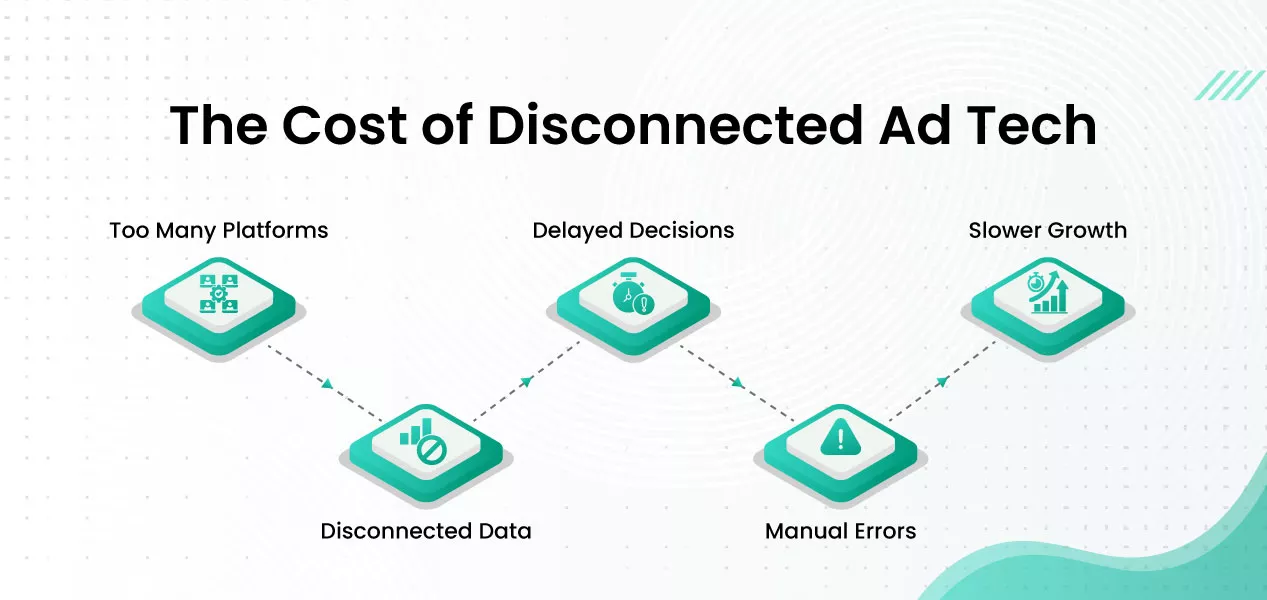
Every time a marketer switches between platforms, exports a file, reconciles two reports, or waits for data to sync, the business pays a toggle tax.
It rarely appears as a direct cost. Now, it shows up as lost opportunities, slower optimization, and teams spending more time keeping systems running than improving campaigns.
Here is what that looks like in practice:
- Ghost spend: A campaign is paused in one platform, but budget continues running elsewhere because the update was not reflected immediately.
- Decision lag: Teams make today’s budget choices using yesterday’s performance data.
- The copy-paste trap: Analysts spend hours moving numbers between dashboards instead of interpreting what those numbers mean.
- Report friction: Marketing, finance, and leadership work from different versions of campaign performance.
- Delayed optimization: By the time an issue is identified, reviewed, and corrected, valuable budget has already been spent.
These are not minor workflow problems. They affect campaign quality, team capacity and how quickly a business can react.
Seamless Ad Tech Integration Improves Decision Quality
Integration is often framed as a way to save time. That is true, but it is only part of the value. The larger advantage is better decision-making.
When campaign, audience, inventory, and performance data flow into one operating view, marketers can understand what is happening without first reconstructing the story from separate systems. Pacing becomes more accurate. Budget shifts happen earlier. Reporting becomes consistent.
This is particularly important for teams managing activity across multiple channels. A connected stack supports the kind of cross-channel programmatic strategy that is difficult to execute when each platform holds only one piece of the customer journey. With seamless ad tech integration, campaign management becomes proactive rather than corrective. Teams identify patterns while they still matter, not after the reporting cycle has closed.
Middleware Is the Glue, Not the Replacement
Many organizations respond to fragmentation by searching for one platform that promises to do everything.
That usually creates a different version of the same problem. The better answer is middleware. Middleware does not ask teams to abandon every tool they already trust. It creates a layer between those tools so data, signals, and actions can move without constant manual intervention.
A well-integrated environment allows a demand-side platform to exchange information with analytics, inventory, attribution, and reporting systems in real time. The marketer does not need to manage every connection separately.
This is what seamless ad tech integration should achieve. Not another dashboard to monitor, but fewer operational gaps to manage. The difference is subtle but important. A unified interface is useful. A unified workflow is transformative.
What Changes When the Stack Works Together
Once fragmentation is reduced, the impact spreads across the wider marketing operation.
Budget pacing becomes easier to control because data arrives faster. Campaign teams work from the same performance view. Reporting errors decline because fewer numbers are transferred manually. Media buyers gain more time to evaluate audiences, creative, and outcomes rather than checking whether systems have synchronized.
The technology becomes less visible. That is usually a sign that it is working well. Good infrastructure does not demand attention. It removes the need for attention, allowing marketers to focus on the decisions that actually require human judgment.
The Admozart Approach
At Admozart, the goal is not to replace every platform marketers already use. It is to make the wider programmatic ecosystem work more cohesively. Our infrastructure connects supply, demand, and media execution so that fragmented processes can operate as a more coordinated whole.
This reduces operational friction from different workflows and gives teams better visibility into campaign performance.
For us, seamless ad tech integration is not about adding complexity behind a polished interface. It is about removing the manual effort that prevents teams from acting quickly and confidently. The technology should handle the movement of data. Marketers should decide what to do with it.
Simplify the Stack to Scale the Strategy
In 2026, the most successful marketing teams will not necessarily have more technology than their competitors. They will simply spend less time managing it.
The toggle tax grows quietly. One export, one delayed report, and one disconnected decision at a time. But the cost eventually becomes visible in slower campaigns, overstretched teams, and media budgets that cannot move quickly enough.
A more integrated approach restores that lost capacity.
The future of marketing operations is not another tab. It is an ecosystem where the tabs no longer need constant supervision. That is the direction shaping how modern programmatic infrastructure is evolving.
Comments are closed