For more than a decade, digital advertising revolved around one central promise: if your ad is viewable, it has a chance to work. That philosophy shaped benchmarks, reporting frameworks, and even budgeting decisions. But in 2025, that belief feels painfully outdated. An ad can be technically viewable while the user is doom-scrolling, distracted, or simply not looking anywhere near the creative.
The truth is simple: visibility is not attention. And in an industry where human focus is now the rarest commodity, the old rules of the viewability era no longer tell us whether media is actually working. This is the shift that defines the modern Attention Economy—a landscape where brands compete not for screen space, but for cognitive space.
As budgets get more tightly scrutinized and advertisers push for meaningful outcomes, attention metrics have emerged as the new currency of programmatic advertising, replacing the superficial comfort of high viewability rates with deeper measurement of real user focus.
Why Viewability Has Reached Its Limit
Viewability was never designed to measure impact—it was designed to confirm possibility. It answers just one question: Was the ad on screen long enough to potentially be seen?
But the assumption that “on screen = noticed” breaks instantly when you observe real users. People skim, scroll quickly, switch tabs, or watch content in split-screen mode. A static 70% viewability score doesn’t reveal whether the user processed anything the brand tried to communicate.
This is why modern performance strategies now evaluate media on a three-layer hierarchy:
1. Viewability—The Basic Requirement
Did the ad technically meet MRC standards?
2. Attention—The Quality Layer
How long did the user actively look at it? How engaged or cognitively present were they?
3. Engagement—The Outcome Layer
Did the user respond? Did it drive clicks, video completions, or brand lift?
Viewability is now limited to the floor. Attention is the ceiling. And it’s the only layer proven to correlate directly with stronger brand recall, lower-funnel conversions, and incremental ROI.
What Attention Metrics Actually Measure
Unlike viewability’s binary nature, attention metrics analyze real behavioral signals that reflect human focus. AI-driven measurement systems capture a more complete picture using indicators such as
- Dwell Time (Time-in-View): How long the ad remained in an active viewport—and how long the user actually stayed with it. The longer the dwell time, the higher the cognitive absorption.
- Scroll Depth & Scroll Velocity: How far and how fast the user moved on the page. Slower scrolling or pausing near an ad typically signals higher attention.
- Active Time in View: Whether the user was actively on the tab—not multitasking in background windows. This filters out wasted impressions immediately.
- Screen Real Estate: The percentage of the screen your ad occupies. Larger, cleaner formats tend to win higher attention scores.
Together, these signals form an Attention Score, a predictive metric showing the likelihood that a placement will drive meaningful impact. Attention scoring—already being adopted globally—is quickly surpassing viewability as a more accurate, future-proof KPI.
AI Is Redefining How We Measure Human Focus
The real breakthrough lies in how AI-driven measurement elevates attention beyond basic behavioral tracking. Modern models interpret environmental and emotional cues that reveal why certain impressions perform better.
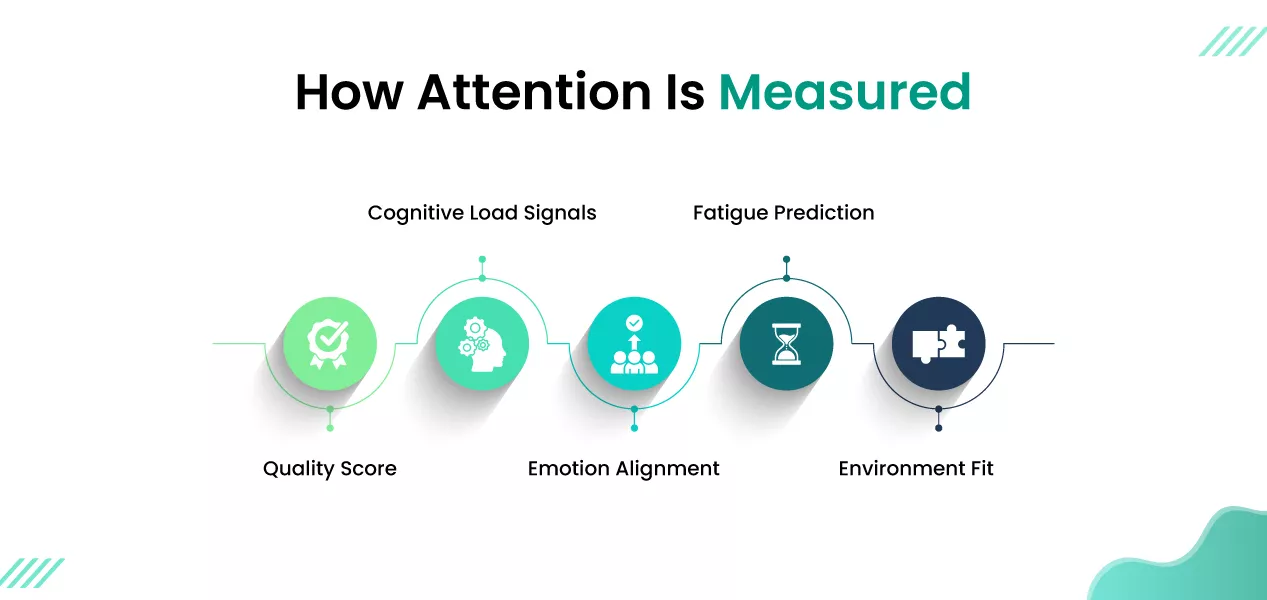
AI now evaluates:
- Contextual Relevance: Checking semantic alignment between the ad and surrounding content to ensure the message appears during moments of high user focus—not just on random “brand safe” pages.
- Creative Effectiveness: Analyzing historical attention patterns across colors, movement, framing, pacing, and messaging to determine which version of a creative is more likely to hold attention in a given environment.
- Fatigue Prediction Models: Forecasting the exact moment a user begins to ignore repetitive impressions, preventing overserving and protecting attention quality.
This predictive layer is what transforms programmatic buying from simply winning impressions to winning meaningful time and cognitive space.
How Admozart Helps Brands Thrive in the Attention Economy
At Admozart, we’ve moved beyond the limitations of legacy viewability filters. Our approach aligns with how attention behaves in the real world—not just how ads load on screens.
We optimize campaigns by:
Shifting Spend Toward High-Attention Environments
Not all impressions are equal. We integrate attention scoring to prioritize inventory that consistently delivers longer dwell time and lower scroll velocity.
Sequencing Creatives Based on How Attention Shifts Across the Funnel
Some formats capture instant attention; others sustain it. We analyze these nuances to build strategies that feel cohesive and effective across screens.
Adopting Privacy-Safe, Cookieless-Ready Attention Signals
Because attention metrics rely on environment and behavior—not user identity—they are fully aligned with the privacy-first future of programmatic advertising.
The mission isn’t just to serve ads—it’s to earn human attention, the one metric that ultimately predicts performance.
Conclusion
In an industry drowning in impressions and surface-level metrics, attention has become the clearest indicator of media quality. Viewability may confirm presence, but attention confirms impact—and brands that optimize for it will consistently outperform those chasing outdated KPIs.
The future of the Attention Economy belongs to advertisers who understand this shift and adopt smart, AI-driven measurement strategies. At Admozart, we help brands build campaigns that are engineered for attention—not just visibility—so every impression contributes to lasting brand value and measurable ROI.
Comments are closed