
For years, the promise of programmatic advertising rested on one idea: automation would bring precision. We told brands they could scale performance without friction by letting algorithms handle buying and optimization. Yet as we move into 2026, many advertisers are hitting a ceiling. Results plateau. Costs creep up. Frequent waste becomes harder to ignore.
The issue isn’t a lack of data. In fact, there are more signals available today than ever before. The real problem is fragmentation. Programmatic didn’t fall short because the technology was weak. It struggled because execution was divided into silos, with display, video, CTV, and mobile treated as separate tracks rather than parts of a single experience.
When media stops working together, performance quietly erodes.
How Media Silos Quietly Erode ROI
In practical terms, a media silo forms when channels are planned, optimized, and measured independently. Each team or platform pursues its own KPIs, often without visibility into what the others are doing. On paper, this procedure looks efficient. In reality, it creates a hidden “silo tax.”
CTV may optimize for completion rates, while display chases clicks. Mobile focuses on installs, while video pushes reach. Each channel can report success, yet the user experiences something very different: repetition, inconsistency, and creative fatigue.
The most visible symptom is frequent waste. Without a shared decisioning layer, a user might see a brand’s ad on a smart TV, then encounter the same message repeatedly on mobile and desktop shortly after. The platforms aren’t aware of one another, so they continue bidding as if each impression exists in isolation. Budget is spent, but the impact diminishes.
Creative signals also fracture. One channel may discover that minimal visuals perform best, while another pushes high-energy formats. If a central intelligence fails to reconcile these insights, it dilutes rather than reinforces the brand story.
Why Channel-Based Planning No Longer Matches Real Behavior
People don’t experience marketing in formats. They experience moments.
No one wakes up intending to engage with “mobile display” or “video inventory.” They’re reading, researching, commuting, or unwinding. Intent is shaped by context, attention, and environment, not by the pipe through which an ad is delivered.
This is why channel-based planning feels increasingly outdated. A high-attention moment on a niche site can be more valuable than a low-attention impression in a premium environment. When planning revolves around formats instead of signals, relevance suffers.
The shift happening across the program is subtle but important: from being everywhere to being meaningful where it matters.
Unified Decision-Making
Unified decision-making replaces fragmented optimization with a single intelligence layer. Execution still happens across channels, but the decision to bid is made centrally.
Instead of asking whether an impression is cheap enough for a banner or large enough for video, unified decision-making evaluates the moment itself. Context, predicted attention quality, creative exposure history, and environment are weighed together before a bid is placed.
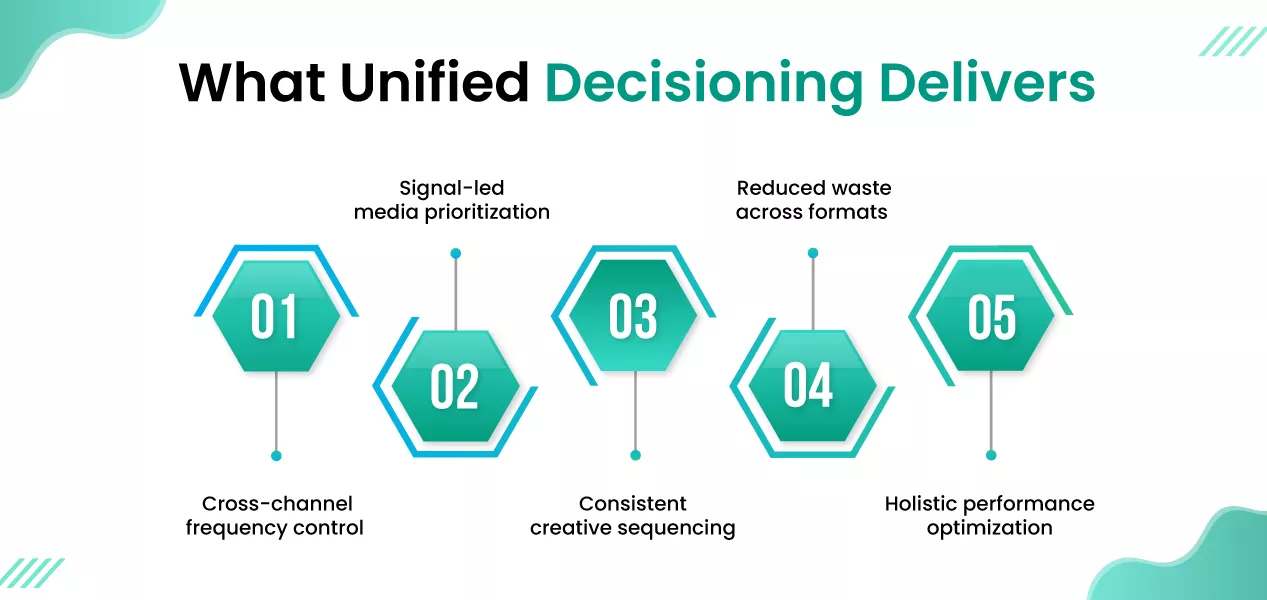
This ensures that each impression builds on the last rather than competing with it. Frequency is managed across channels. Creative sequencing becomes intentional. Budget flows toward quality signals, not isolated delivery targets.
What Unified Decisioning Actually Solves
When programmatic performance starts to plateau, the issue is rarely budget or reach. It’s usually fragmentation. Unified decisioning exists to solve the hidden inefficiencies that emerge when channels, signals, and creatives operate in isolation. This is where performance gains are recovered.
Why Infrastructure Determines Media Quality
Unified decision-making isn’t just a strategic mindset; it’s an infrastructure requirement. The intelligence has to operate pre-bid, not after delivery.
In older programmatic models, optimization often happened in hindsight. Teams reviewed reports, identified what worked, and adjusted tomorrow’s spend. In 2026, that lag is costly. Signals lose value quickly, and impressions must be evaluated in milliseconds.
Clean inventory paths matter here. Supply-side discipline ensures that context, viewability, and attention signals remain accurate instead of distorted by unnecessary intermediaries. This is where modern programmatic infrastructure, especially when working through contemporary demand-side platforms, becomes essential to maintaining signal integrity at scale.
How Admozart Approaches Unified Decisioning
At Admozart, unified decision-making isn’t treated as an add-on or reporting layer. It’s built into how impressions are evaluated in the first place.
Rather than optimizing channels independently, the focus stays on how signals intersect. Context, attention, environment, and creative response are analyzed together so that each bid reinforces a broader strategy instead of competing within it. The goal isn’t to maximize exposure; it’s to maximize meaningful moments.
By grounding decision-making in real-time signals instead of fragmented identifiers, performance becomes more stable, more respectful of the user experience, and more resilient in a privacy-first landscape.
Conclusion
Media silos didn’t become obsolete because they were inefficient. They became obsolete because they no longer reflect how people behave. The future of programmatic advertising doesn’t belong to brands that buy everywhere. It belongs to brands that decide intelligently once and execute consistently everywhere. Unified decisioning aligns relevance, attention, and performance into a single system, one that values media quality over media volume. In a landscape defined by complexity, the most powerful strategy is coherence.
Comments are closed