For years, supply path optimization was one of the least glamorous but most important jobs in programmatic. It meant spreadsheets, audits, static SPO rules, and long reviews of which intermediaries were adding value and which were simply adding cost. The work was necessary, but it was always reactive. Traders identified inefficient paths after budget had already leaked through them. That approach no longer scales.
In 2026, the supply chain has become too dynamic, too fragmented, and too expensive to manage manually. Between duplicate bid requests, latency penalties, and growing carbon accountability, the real challenge is no longer choosing a better path. It is choosing the best path in the moment. That is where Agentic Curation enters the picture.
Instead of relying on static SPO logic, advertisers are now using autonomous decision layers that continuously evaluate which routes to inventory are most efficient, most direct, and least wasteful in real time.
This is the year the supply path stopped behaving like plumbing and started acting like intelligence.
From Manual SPO to Agentic Curation
Traditional SPO was built on historical logic. Teams reviewed performance reports, removed poor-performing sellers, and gradually refined whitelists over time. It worked when the ecosystem was slower.
But the modern auction environment changes by the millisecond. A single impression may still appear through multiple routes, each carrying different fees, latency, and sustainability costs. Static rules cannot adapt fast enough.
Agentic Curation changes that by shifting the decision from humans to autonomous reasoning systems.
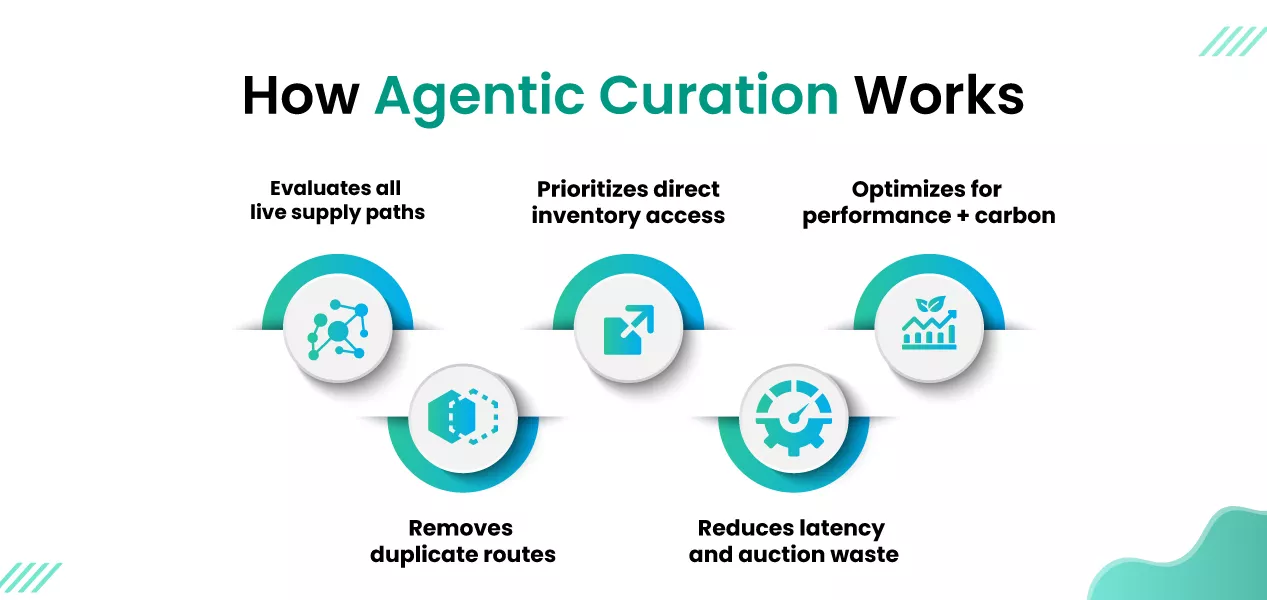
These systems do not simply follow whitelists. They evaluate current auction conditions, duplication signals, hop count, path integrity, and environmental cost before deciding which route to spend. The result is a self-improving supply layer that learns continuously instead of waiting for the next SPO review cycle.
The Bid Bloat Problem Nobody Wants
One of the biggest hidden costs in programmatic remains bid bloat.
The same impression can be replicated across too many parallel paths, creating noisy auctions, unnecessary infrastructure strain, and distorted pricing signals. The result is not just inefficiency. It is confusion.
When too many paths compete for the same opportunity, performance measurement becomes harder and the real value of supply becomes less visible. Agentic Curation solves this at the decision layer by pruning routes before the auction scales unnecessarily.
What Agentic Curation Filters
- Duplicate or redundant bid paths
- Low-integrity intermediary hops
- High-latency routes
- Carbon-heavy supply chains
- Paths with poor Human CPM correlation
This allows advertisers to focus on quality execution rather than infrastructure waste.
The 2026 supply path is not just a cost decision. It is increasingly a sustainability decision.
Every unnecessary intermediary adds compute load, server requests, and energy consumption. In a market where ESG goals are now influencing media planning, inefficient supply chains create both budget waste and environmental costs.
This is why Agentic Curation now factors carbon efficiency into path selection.
The smartest route is no longer just the cheapest. It is the route that minimizes hops, reduces duplication, and aligns with greener infrastructure standards without sacrificing performance.
For enterprise advertisers, this is becoming a board-level consideration rather than an operational preference.
Admozart as the Curated Layer
This shift only works if the underlying exchange environment is clean enough for intelligent routing to matter.
At Admozart, the supply layer is already structured around this principle.
Instead of forcing buyers to navigate the noise of legacy exchanges, Admozart functions as a curated access layer where high-performing, authenticated, and direct routes are already prioritized. This gives agentic systems a cleaner decision space to work within.
That matters because AI performs best when the supply graph is already filtered for quality.
The role of Admozart here is not to overwhelm the bidder with more routes but to make the buying layer smarter, faster, and cleaner before the decision engine even begins. It is to reduce bid bloat before the decision engine even begins, making Agentic Curation faster, more precise, and more reliable.
The New Role of the SPO Strategist
This does not make the SPO strategist obsolete. It changes the role from operator to architect.
Instead of manually blocking inefficient sellers, strategists now define the goals the agent must optimize toward: quality thresholds, cost ceilings, Human CPM alignment, and carbon boundaries.
The tactical work moves to the machine.
The strategic logic stays with the human.
That shift is important because the value of expertise is moving upstream.
The best buyers in 2026 are no longer the ones who manage whitelists best. They are the ones who define better optimization intent.
The Supply Path Finally Got Smart
The progression from Human CPM to Agentic Curation is a natural one. First, the industry learned that not every impression is worth buying. Now it is learning that not every path is worth taking. This is what makes 2026 such an important turning point.
The supply chain is no longer passive infrastructure. It is becoming an active decision layer that optimizes for efficiency, transparency, sustainability, and real performance at once.
That is what Agentic Curation ultimately represents. Not more automation. Better judgment at scale.
Comments are closed