There’s an old line in advertising that still gets repeated today: half the budget is wasted; you just don’t know which half. For a long time, that wasn’t just a joke. It was how marketing worked.
Campaigns were built around reach, not relevance. Ads were placed where audiences existed, not where intent existed. Some of it worked. A lot of it didn’t. And the gap between spend and outcome was accepted as part of the process.
That model doesn’t hold anymore.
In 2026, reducing ad waste with precision targeting has become a baseline expectation. With better data, faster execution, and smarter buying systems, there’s no reason to keep paying for impressions that were never going to convert in the first place.
What Ad Waste Actually Looks Like
Ad waste isn’t always obvious. It doesn’t show up as a single line item. It’s spread across small inefficiencies that add up over time.
You see it when ads reach the wrong geography.
When messaging lands in front of audiences with no buying intent.
When impressions are served to bots instead of people.
Or when the same user sees the same creative too many times and stops paying attention altogether.
Each of these moments feels minor on its own. But together, they quietly drain performance. And once you start measuring closely, you realize how much of your budget never had a real chance to work.
Why Reducing Ad Waste With Precision Targeting Matters
The shift isn’t just about saving money. It’s about using your budget with intent.
When you focus on reducing ad waste with precision targeting, you move from broad exposure to controlled delivery. You’re no longer buying space. You’re buying relevance, which aligns with the broader shift where engagement is replacing impressions as the real performance signal.
That changes how campaigns behave.
Instead of hoping the right audience sees your ads, you define who qualifies before the impression is even considered. That single shift removes a large portion of inefficiency before spending even begins.
How Precision Targeting Actually Works
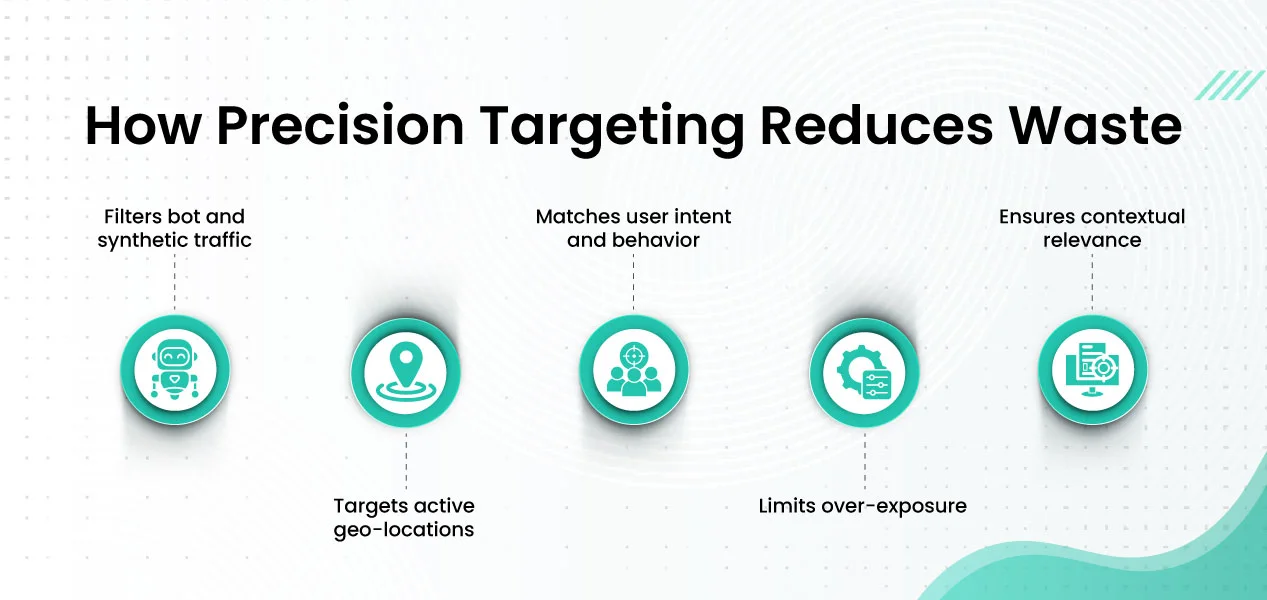
Precision targeting isn’t one feature. It’s a layered system that filters impressions in real time.
Here are the core levers that make it effective:
Key Layers of Precision Targeting
- Behavior and intent signals
Ads reach users who are actively researching or showing interest in related categories. - Location accuracy
Campaigns are restricted to regions that actually matter to the business. - Device and context alignment
Ads appear where they make sense, based on how and where the user is engaging. - Frequency control
Exposure is managed to avoid repetition and fatigue. - Traffic validation
Impressions are filtered to reduce bot and synthetic activity.
Each layer removes a different type of waste. Combined, they create a much tighter and more reliable delivery system.
The Real Impact on Budget Efficiency
This is where the difference becomes visible.
Think of a fixed budget. Without targeting, a portion of that spend inevitably reaches the wrong audience. Some impressions go to bots. Some go to irrelevant users. Some are simply ignored.
What remains is your “effective” budget.
When you focus on reducing ad waste with precision targeting, that effective portion grows. Not because you’re spending more, but because you’re losing less along the way.
The outcome is simple. More of your budget reaches people who actually matter. Performance improves without increasing spend. That’s what makes this budget shift practical, not theoretical.
Where the DSP Changes the Game
This level of control isn’t possible without the right infrastructure.
A demand-side platform acts as the decision layer behind every impression. It evaluates whether a user matches your criteria before placing a bid. That’s what turns targeting into filtering rather than guesswork.
Instead of buying inventory in bulk, the system selects impressions one at a time based on relevance. That’s the core mechanism behind reducing ad waste with precision targeting.
The Admozart Approach to Efficiency
At Admozart, the focus is not just on enabling targeting, but also on ensuring that targeting translates into measurable efficiency.
The platform is designed to filter supply before it reaches the buyer, prioritize cleaner inventory paths, and align delivery with real audience signals. This reduces unnecessary exposure and keeps campaigns focused on outcomes.
The goal is straightforward. Make sure impressions are not just made, but made with purpose. Because efficiency isn’t created after the campaign runs. It’s built into how impressions are selected.
Making Every Impression Count
The biggest shift in modern advertising isn’t about new formats or new channels. It’s about how carefully budgets are used.
Reducing ad waste with precision targeting forces a change in mindset. It replaces broad reach with intentional reach. It moves decision-making earlier in the process, where it has the most impact.
And once that shift happens, performance stops being unpredictable. It becomes measurable.
Comments are closed